
Intack Primary School Proud to Belong
Implementation
At Intack, writing is taught through the use of high-quality texts and we encourage our children to use and develop inference skills, build on vocabulary, have exposure to a range of punctuation and grammar and use the opportunity to engage with and ‘lose themselves’ in these exciting age-appropriate texts.
English teaching is based around themes or topics, ensuring that children are given a real-life purpose for writing, with the aim of developing an enjoyment of writing.
Children are taught to explore the writing structures and features of different genres, identify the purpose and audience, plan and write an initial piece of writing with a clear context and purpose before going on to evaluate the effectiveness of writing by editing and redrafting. Teachers model the editing process as well providing good quality (written and verbal) feedback. Children are given the time to edit and redraft their work and pupil conferencing allows for verbal discussions on how to further improve writing.
Every classroom has an ‘English working wall’. These are updated regularly and are designed to support and encourage independent writing. English working walls are also used to promote and celebrate a love of writing.
Teachers will provide children with the opportunities to embed their skills in writing through additional cross-curricular writing opportunities.
Our Writing Curriculum Offer (guidance taken from LCC Writing Units)
Key Learning Objectives
The Key Learning in Reading and Key Learning in Writing documents we adopt from Lancashire County Council, outline the complete coverage of the National Curriculum for English and provide the basis for constructing a unit of English. These are frequently broken down further by teacher to form lesson objectives.
The Teaching Sequence
A suggested unit outline follows the teaching sequence:
- Creating Interest: Reading and responding; Reading and analysing
- Gathering content
- Writing
- Presentation
The image below shows a typical teaching sequence for each of our writing units.
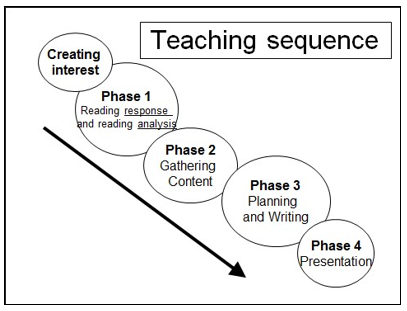
It's important to note that the amount of time spent in any one phase needs to be tailored to the needs of the class.
Writing Outcomes
Extended Writing Outcomes:
Each unit of work should result in at least two (and possibly three) extended, written outcomes.
This allows children several opportunities to practise and apply newly acquired skills in context. Outcomes are identified as follows:
Scaffolded Outcomes
This is completed on a daily basis during the writing phase. It is supported through daily, whole-class, shared and modelled writing. It may be further supported by small-group, guided writing for some pupils. Each section is supported through teaching, with the children working on their own version following the teacher’s model. For a narrative unit, this might appear like this:
|
|
Teacher’s Role |
Children’s Role |
|
Day 1 |
Shared writing/modelling – story opening |
Writing their own opening |
|
Day 2 |
Shared writing/modelling – build up |
Writing their own build up |
|
Day 3 |
Shared writing/modelling – problem |
Writing their own problem |
|
Day 4 |
Shared writing/modelling – resolution |
Writing their own resolution |
|
Day 5 |
Shared writing/modelling – ending |
Writing their own ending |
The effectiveness of this model is enhanced by:
- feedback and marking on a daily basis and pupils being given time to respond;
- use of ideas and vocabulary gathered during earlier phases displayed on the working wall;
- displaying the shared and modelled writing from across the writing phase.
Independent extended writing outcomes
This is a second opportunity for the children to write in the same genre or text-type, but this time, more independently. Generally, this would take one (or at most two lessons) and should take place soon after the completion of the unit. The children should have time to think, plan and discuss their ideas and they should also have access to prompts created through the unit, e.g. content from the working wall, genre checklists, word banks, dictionaries etc.
Crucially however, there should be no adult modelling of writing to support the completion of this second outcome.
As well as giving children another opportunity to apply their skills, this outcome is very useful to inform assessment and next steps in teaching and learning. Consequently, feedback and marking for this outcome might be less in-depth and feature on completion of the piece only. This provides an ideal opportunity for pupils to make improvements to their independent writing via redrafting and self-editing. The piece can still be used for assessment purposes, provided that the process is not over-scaffolded by the teacher and is the result of the child's own improvement.
Cross-curricular application
This works best for non-fiction units. It usually takes place some time after the completion of the English unit and is done in another area of the curriculum. This provides opportunity for children to revisit text types and revise skills. Pupils should be given time to refresh their knowledge and understanding of the text type, looking back at their own writing and prompts created. Again, this outcome is particularly useful for assessment purposes and children should be given opportunity to edit and improve their own writing.
Publishing Writing
Children invariably write more effectively when they have a real audience and purpose for their writing. Thought should be given to this at the outset and shared with the children. This might involve:
- writing stories to entertain, for example: arranging an opportunity for the children to share their stories in small groups;
- writing, then redrafting, non-chronological reports to make a class book which is put on display in the school library;
- children reading, rehearsing and performing their own poetry to be recorded and shared on the school website.
Short writing
Of course, all writing must not be left until the writing phase! Writing skills need to be constantly practised and revisited throughout the reading and gathering content phases. Outcomes should be linked to a specific learning objective e.g. LO: To infer character thoughts and feelings – Outcome: diary.
Examples of short writing opportunities include:
- diary entries
- character profile
- dialogue exchange
- fact file
- letter to a problem page
- book review
Grammar and Punctuation
An age-appropriate grammar and / or punctuation focus should be selected for each unit, based on the genre or text type from the unit. However, it is important that teachers consider the children’s current skills in relation to grammar and adjust this focus if necessary. For example, it is not appropriate to teach main and subordinate clauses to a Year 3 class who are not secure with simple sentence construction.
As well as the acquisition of grammar skills, knowledge and terminology, it is important that children are shown how to apply these appropriately in their own writing.
The process involves:
- Short, sharp grammar warm-ups - a highly effective way of introducing and practising the skills initially;
- The teacher modelling the appropriate application during the writing phase;
- Establishing the expectation that the children will apply the skills appropriately in their own writing;
- The children having opportunity to self and peer assess;
- Teacher feedback and marking which reflects the grammar or punctuation focus.
It is advisable to address one or two objectives for grammar and/or punctuation within a unit; this allows skills to be taught and secured through a ‘little and often’ approach.